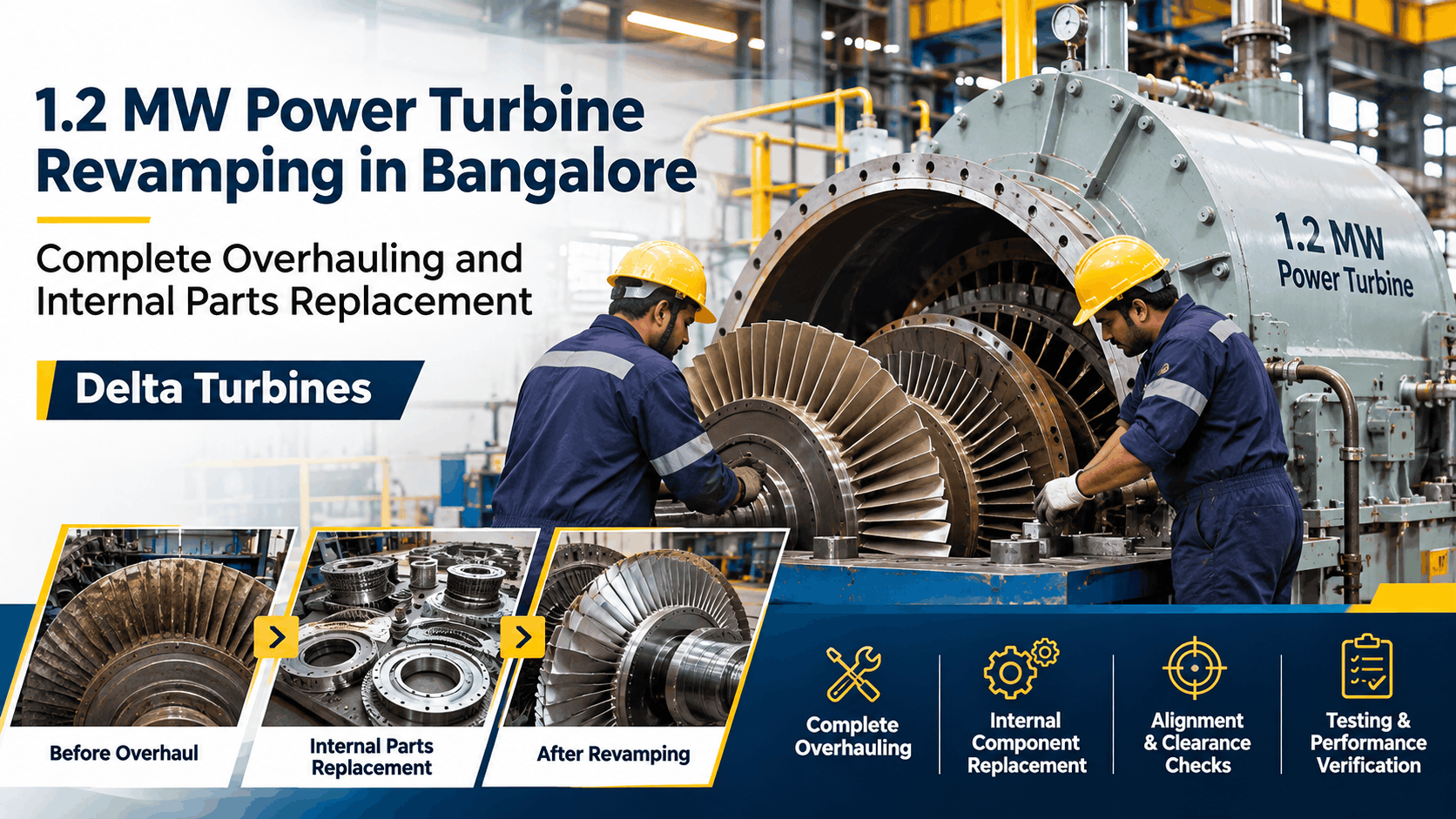
Industrial power turbines play an important role in supporting continuous operations across manufacturing plants, industrial facilities and power generation systems. Over time, turbine components may experience wear, performance variations and mechanical deterioration due to continuous operation.
Regular inspection, maintenance and timely revamping are essential to maintain operational reliability and extend equipment service life.
Delta Turbines undertakes 1.2 MW power turbine revamping in Bangalore, focusing on complete overhauling and the replacement of internal parts. Revamping an existing turbine provides an opportunity to inspect critical components, address worn or damaged parts and restore the equipment to its required operating condition.
Power turbine revamping is a comprehensive process involving the inspection, dismantling, servicing, repair and replacement of selected internal components of an existing turbine.
A 1.2 MW turbine revamping project requires a systematic approach to understand the equipment's condition and identify components that need attention.
The process may include:
The scope of work depends on the turbine design, operating history and inspection findings.
Continuous turbine operation can gradually affect the condition of internal mechanical components. Wear, operating conditions, vibration and other factors may influence equipment performance.
Complete overhauling helps identify potential issues and provides an opportunity to address them before they lead to more significant operational problems.
A systematic revamping process is essential to ensure that every major maintenance requirement is properly addressed. The exact procedure depends on the turbine model, manufacturer specifications and equipment condition.
The first stage involves understanding the existing condition of the 1.2 MW power turbine. The inspection focuses on identifying visible damage, component wear, operational concerns and areas requiring detailed examination.
Important activities may include:
This initial assessment helps establish the appropriate revamping requirements.
After the initial assessment, the turbine is dismantled according to the applicable maintenance procedure. Internal components are carefully removed and inspected to determine their condition.
The inspection may cover:
This stage is important because some component issues may not be visible during an external inspection.
Internal component replacement is one of the important stages of turbine revamping. Components showing excessive wear, damage or deterioration may require replacement based on inspection findings and applicable technical specifications.
The replacement process should consider component compatibility, dimensional requirements, material specifications and manufacturer recommendations.
Properly selected replacement parts help support reliable turbine operation and reduce the possibility of issues associated with unsuitable components.
Correct clearances and alignment are important considerations during turbine reassembly. Incorrect clearances or alignment can contribute to mechanical contact, vibration and operational difficulties.
During revamping, relevant checks may include:
These checks should follow the applicable turbine specifications and technical requirements.
After inspection and the required component replacement, the turbine is reassembled following the appropriate technical procedures.
Mechanical checks are carried out to confirm that components are correctly fitted and the assembly meets the required specifications. Attention to detail during reassembly is important for supporting equipment reliability and safe operation.
The final stage involves carrying out applicable mechanical checks and testing procedures.
Depending on the project scope and equipment specifications, verification may include:
Testing requirements should be established according to the turbine manufacturer's specifications and the agreed project scope.
Internal turbine components operate under demanding mechanical and thermal conditions. Their condition can influence the overall operation of the equipment.
Replacing components that do not meet the required specifications can help address existing mechanical concerns.
Component replacement decisions should always be based on proper inspection and technical evaluation rather than routine replacement without assessment.
When an industrial turbine experiences performance or maintenance issues, businesses may consider either complete equipment replacement or revamping the existing turbine.
Revamping may be a practical option when the existing equipment is suitable for refurbishment and its major components can be restored or replaced within the required technical specifications.
Potential advantages include:
The decision should be made after evaluating the turbine's overall condition, availability of compatible components, maintenance requirements and long-term operating needs.
Power turbines are used in different industrial environments depending on their design, configuration and operating requirements.
Potential application areas may include:
The suitability of a particular 1.2 MW turbine depends on its technical specifications and intended application.
Delta Turbines undertakes 1.2 MW power turbine revamping work involving complete overhauling and internal parts replacement.
A structured revamping approach helps identify the condition of existing components and determine the maintenance requirements necessary for the project.
The work focuses on important aspects of turbine refurbishment, including:
For industrial facilities planning turbine maintenance or refurbishment, understanding the existing equipment condition is an important first step.
Delta Turbines focuses on addressing the revamping requirements of existing power turbine systems through systematic inspection, component replacement and overhauling activities.
A 1.2 MW power turbine is an important piece of industrial equipment that requires appropriate maintenance to support reliable operation. Complete turbine revamping, including internal parts replacement, provides an opportunity to inspect the existing assembly, address component wear and improve the condition of the equipment.
From initial inspection and dismantling to internal component replacement, reassembly and final verification, every stage of the revamping process requires careful technical attention.
For businesses looking for 1.2 MW Power Turbine Revamping in Bangalore, Delta Turbines undertakes complete overhauling and internal parts replacement work to address the maintenance requirements of existing turbine systems.
Contact Delta Turbines to discuss your turbine revamping requirements and evaluate the appropriate refurbishment scope for your equipment.
1.2 MW power turbine revamping is the process of inspecting, dismantling, overhauling and replacing required internal components of an existing 1.2 MW turbine to address wear and maintenance requirements.
Complete turbine overhauling may include initial inspection, dismantling, internal component assessment, replacement of worn parts, clearance and alignment checks, reassembly and applicable testing.
Internal parts replacement helps address components that have experienced wear, damage or deterioration. It supports proper mechanical operation when replacement components meet the required technical specifications.
Signs such as unusual vibration, abnormal operating conditions, recurring maintenance issues and changes in operating performance may indicate the need for a detailed turbine inspection. A technical assessment is required to determine the appropriate maintenance scope.
Revamping may be a suitable option when the existing turbine is technically suitable for refurbishment. The decision depends on equipment condition, component availability, project cost, technical specifications and long-term operating requirements.
Depending on the turbine design, inspection may cover rotor and shaft assemblies, blades, bearings, seals, casing components and other internal mechanical parts.
The project duration depends on the turbine condition, extent of dismantling, number of components requiring replacement, availability of parts and testing requirements. A reliable timeline can be provided after evaluating the equipment and project scope.
Delta Turbines undertakes 1.2 MW power turbine revamping work in Bangalore, including complete overhauling and internal parts replacement. Contact the company to discuss your equipment requirements.