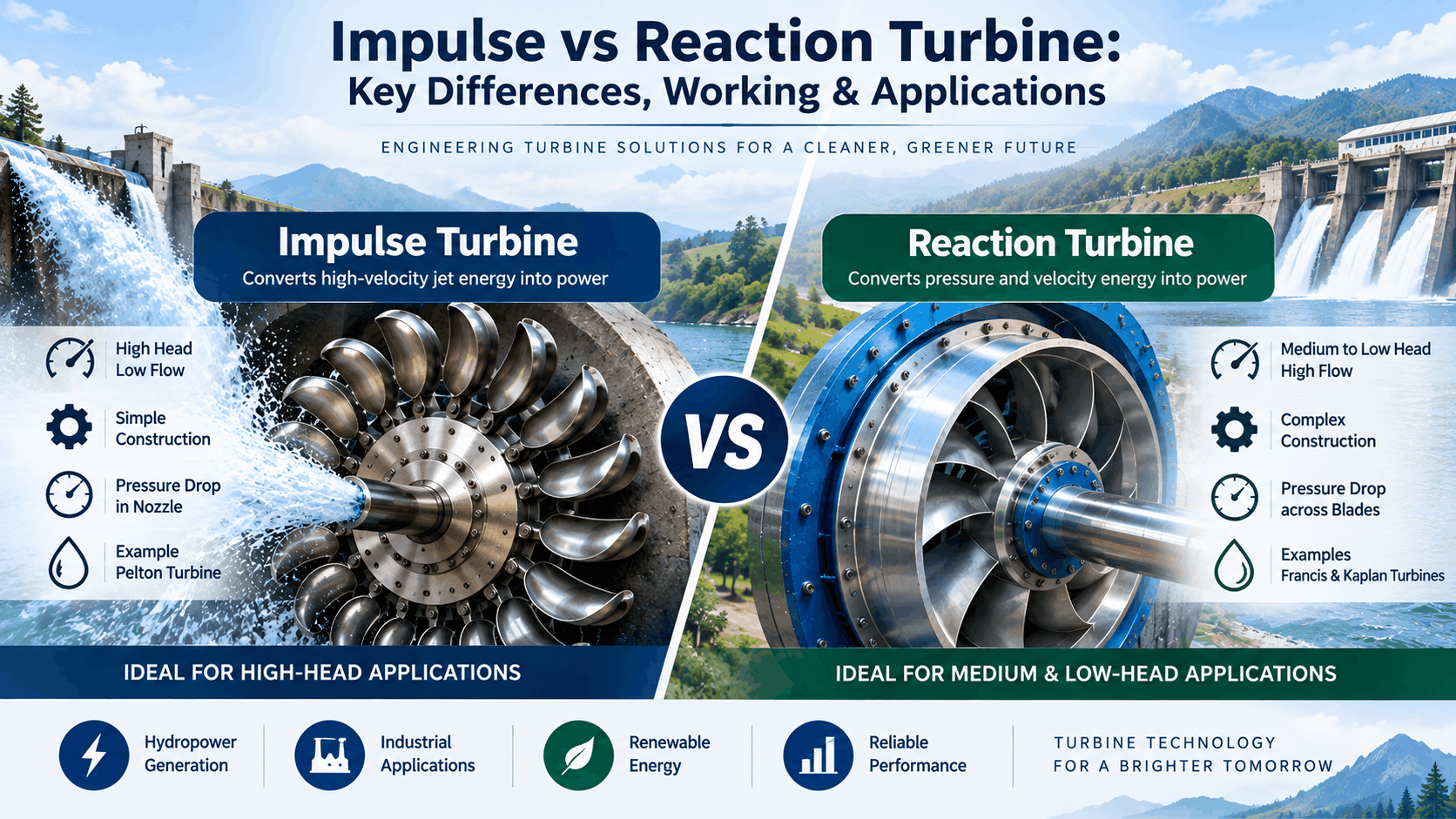
Turbines play a vital role in converting fluid energy into mechanical power for electricity generation and industrial applications. Among the most widely used types are impulse turbines and reaction turbines. Although both operate on the principle of converting fluid energy into rotational mechanical energy, their working mechanisms, pressure changes, construction, and applications differ significantly.
Understanding the difference between impulse and reaction turbines is important when selecting the right turbine for a specific industrial or power-generation requirement. This guide explains their working principles, key differences, advantages, applications, and the factors to consider when choosing between them.
An impulse turbine is a turbine in which the pressure energy of a fluid is first converted into kinetic energy through specially designed nozzles. The high-velocity fluid jet then strikes the turbine blades, causing the rotor to rotate.
In an impulse turbine, the pressure of the fluid remains approximately constant as it passes over the moving blades. Most of the pressure drop occurs in the stationary nozzle.
The working process of an impulse turbine can be explained in a few steps:
Pelton turbines are a common example of impulse turbines and are particularly suitable for applications involving high heads and relatively low flow rates.
A reaction turbine generates power through a combination of pressure energy and kinetic energy. Unlike an impulse turbine, the fluid continues to experience a pressure drop as it flows through the moving blades.
Reaction turbines are designed so that the shape of the blades and the pressure difference across them create a reaction force that rotates the turbine rotor.
The basic working process of a reaction turbine includes:
Francis and Kaplan turbines are widely used examples of reaction turbines, with their suitability depending on factors such as head, flow rate, and operating conditions.
One of the most important differences between impulse and reaction turbines is the pressure change across the rotor.
In an impulse turbine, the major pressure drop takes place before the fluid reaches the moving blades, usually through a nozzle. The fluid then transfers its kinetic energy to the rotor.
In a reaction turbine, pressure continues to decrease as the fluid passes through the moving blades. This pressure difference contributes directly to the force that drives the rotor.
Impulse turbines generally have a comparatively simple rotor arrangement because the pressure drop occurs primarily in the nozzles. The turbine casing does not necessarily have to contain the same pressure conditions experienced by a reaction turbine.
Impulse turbines are commonly selected for applications where there is a high available head and comparatively lower flow rate.
Typical applications include:
Pelton turbines are particularly well suited to high-head hydroelectric installations because they can efficiently convert the kinetic energy of high-velocity water jets into rotational energy.
Reaction turbines are widely used where the available fluid flow and pressure conditions are suitable for continuous pressure reduction through the turbine.
Common applications include:
Francis turbines are widely used for medium-head hydroelectric applications, while Kaplan turbines are generally associated with low-head and high-flow conditions.
Impulse turbines offer several benefits:
The appropriate turbine selection, however, depends on the available head, flow rate, efficiency requirements, and overall plant design.
Reaction turbines also provide several advantages:
Their performance depends heavily on correct blade geometry, pressure management, flow control, and turbine design.
Selecting the right turbine requires an evaluation of the operating conditions rather than simply choosing one turbine type over another.
Important factors include:
The available fluid head is one of the primary factors in turbine selection. High-head conditions often favor impulse turbine designs, while reaction turbines are frequently used for medium- and low-head applications.
The expected flow rate also influences turbine selection. The turbine should be capable of operating efficiently at the required flow range.
The required mechanical or electrical output should be considered when selecting turbine capacity and configuration.
Load variations, fluid characteristics, operating hours, and environmental conditions can affect turbine performance and reliability.
Accessibility, component durability, spare parts availability, and maintenance requirements should be evaluated during the turbine selection process.
The selected turbine should provide efficient energy conversion under the expected operating conditions. Proper sizing and system design are essential for achieving consistent performance.
Delta Turbine India focuses on turbine engineering and solutions for industrial and power-generation requirements. Selecting the appropriate turbine involves understanding operating parameters such as pressure, flow, head, speed, power output, and application requirements.
For industries evaluating turbine technologies, working with an experienced turbine manufacturer can help ensure that the selected system is appropriately designed for the intended operating conditions.
From turbine selection and engineering considerations to installation and maintenance, professional guidance can help improve equipment reliability, energy efficiency, and long-term performance.
The primary difference is how fluid energy is converted into mechanical energy. An impulse turbine primarily uses the kinetic energy and momentum of a high-velocity fluid jet, while a reaction turbine uses both pressure and velocity changes as fluid passes through the rotor.
Impulse turbines such as Pelton turbines are commonly used for high-head applications, particularly in hydroelectric power generation.
Reaction turbines such as Kaplan turbines are commonly used for low-head, high-flow hydroelectric applications.
Ideally, the pressure remains approximately constant as the fluid passes over the moving blades. The major pressure drop occurs in the nozzle before the fluid reaches the rotor.
Yes. In a reaction turbine, the fluid pressure decreases as it flows through the moving blades, contributing to the force that drives the rotor.
Both impulse and reaction turbines are important technologies for converting fluid energy into useful mechanical power. The key difference lies in how pressure and velocity energy are converted and where the pressure drop occurs.
Impulse turbines are generally associated with high-head applications and use high-velocity fluid jets to generate rotor movement. Reaction turbines extract energy through both pressure and velocity changes as fluid flows through the rotor.
Understanding these differences helps engineers and industries select the most appropriate turbine for their operating requirements. For reliable turbine selection and industrial applications, evaluating factors such as head, flow rate, power output, efficiency, and maintenance requirements is essential.
Delta Turbine India can support industries in evaluating turbine solutions based on their specific engineering and operational requirements.