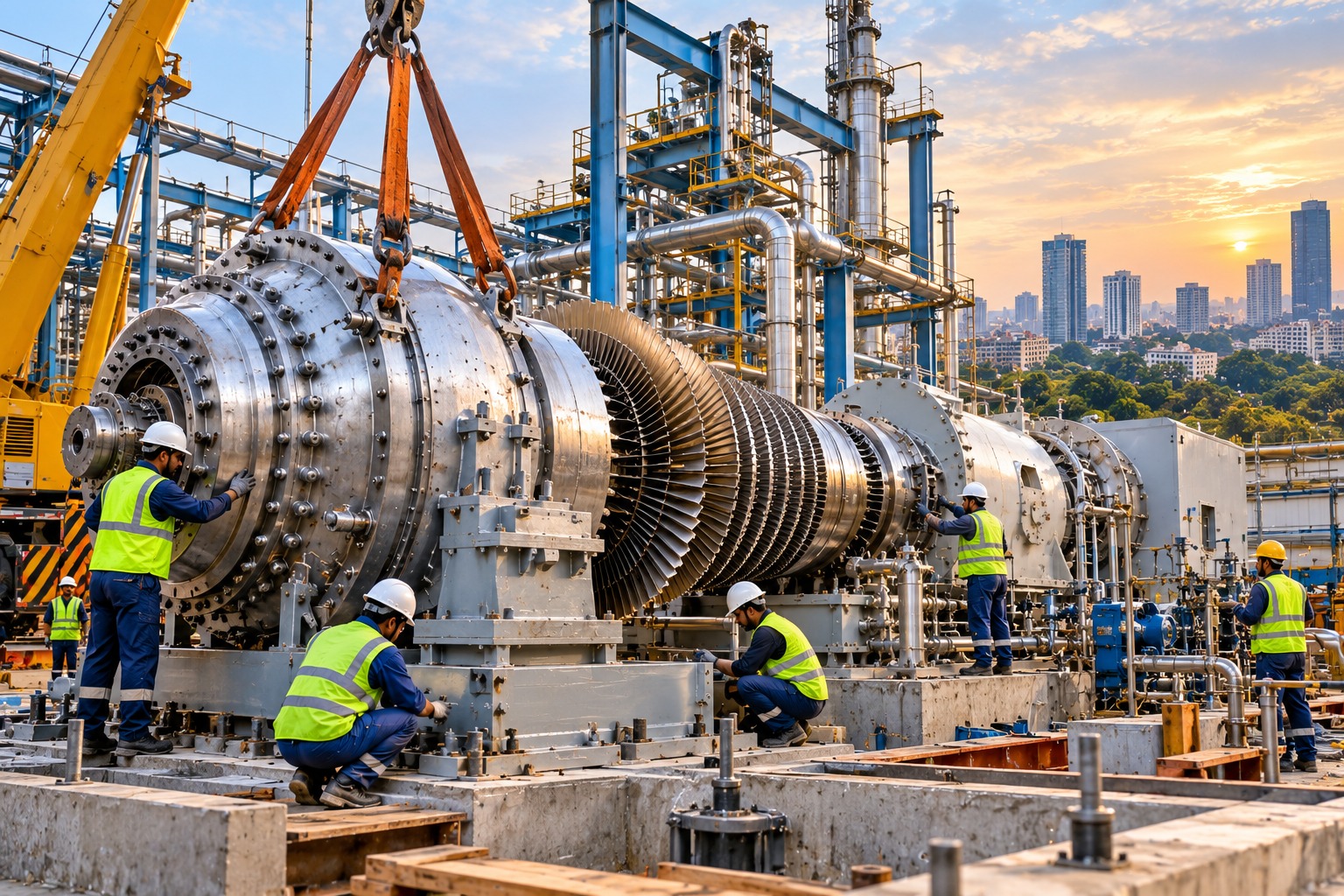
Steam turbines are essential equipment in industrial power generation and mechanical-drive applications. Proper installation and startup are critical to ensuring reliable performance, operational safety, and long-term equipment efficiency of steam turbines across India. Professional steam turbine installation, troubleshooting, servicing, and commissioning help establish a strong foundation for sugar, distillery, and ethanol industry operations.
Delta Turbo Engineers provides technical support for steam turbine installation, from site preparation and equipment positioning to alignment, commissioning, and operational checks. Every stage requires careful planning and adherence to the turbine manufacturer's specifications.
Steam turbine installation involves positioning and assembling the turbine and its associated systems according to approved engineering drawings and technical requirements. Since turbines operate at high speeds and under demanding temperature and pressure conditions, precision is essential throughout the installation process.
A properly installed steam turbine can help reduce avoidable mechanical problems, support efficient operation, and simplify future maintenance activities.
Industrial facilities commonly use steam turbines in:
The installation process begins with a detailed inspection of the site. Engineers review the foundation, installation area, lifting arrangements, piping connections, and access requirements.
The foundation must meet the approved design specifications to support the turbine safely and minimize the risk of vibration or alignment issues during operation.
The steam turbine is carefully transported, lifted, and positioned using appropriate handling equipment. Proper handling protects precision-machined components from damage during installation.
Once positioned, the turbine is checked for level, orientation, and mounting accuracy according to the manufacturer's recommendations.
Shaft alignment is one of the most important stages of steam turbine installation. The turbine shaft must be correctly aligned with connected equipment, such as generators, pumps, or compressors.
Incorrect alignment may result in excessive vibration, bearing damage, coupling wear, and reduced equipment life. Accurate alignment helps support smooth operation and mechanical reliability.
The turbine requires properly installed piping and supporting auxiliary systems to operate safely. These may include:
All connections should be inspected to ensure that they meet project specifications and do not introduce excessive loads on the turbine.
Before startup, the installation team performs essential inspections and functional checks. These checks help identify potential issues before the turbine begins operating.
Typical activities include verifying alignment, checking lubrication systems, inspecting steam lines, testing instrumentation, and confirming that alarms and protective shutdown systems function correctly.
Steam turbine startup is a controlled process that prepares the equipment for operation. It must be performed by qualified personnel in accordance with the manufacturer's instructions and approved site procedures.
The commissioning process generally involves the following activities.
The team confirms that the turbine, piping, lubrication, instrumentation, and auxiliary systems are ready for operation. All required inspections, safety clearances, and commissioning checks must be completed.
The turbine is started according to its approved operating procedure. Where required, steam admission and turbine warming are carried out gradually to manage thermal expansion and minimize mechanical stress.
During startup, operators monitor important operating parameters, including:
These parameters help the commissioning team assess whether the turbine is operating within its specified limits.
After the required startup checks are completed, the turbine may be brought to the specified operating load in accordance with the approved commissioning procedure.
Performance observations and test results are documented to establish an operational baseline.
Any abnormal condition must be investigated before the turbine proceeds to the next stage of operation.
Choosing a qualified installation and commissioning team can provide several benefits for industrial facilities.
Industrial businesses need reliable technical support when installing new steam turbines. Selecting a service provider with relevant turbine experience, qualified personnel, and a clear commissioning process is an important part of project planning.
Delta Turbo Engineers can be considered by businesses located in Bangalore and across India seeking to discuss steam turbine installation and startup requirements.
Before appointing a service provider, customers should confirm the available service scope, equipment-specific experience, safety practices, commissioning capabilities, and post-installation support.
A well-coordinated installation project helps ensure that the turbine, connected machinery, and auxiliary systems are prepared for safe and dependable operation.
New steam turbines can support a range of industrial applications, depending on their design and operating requirements.
Correct turbine selection, installation, and commissioning are important for achieving the intended performance in each application.
The installation and startup of new steam turbines require precision engineering, systematic inspection, accurate alignment, and carefully controlled commissioning. Every stage contributes to equipment reliability, operational safety, and long-term performance.
For steam turbine-related problem solutions and technical support, please feel free to approach Delta Turbo Engineers for professional services.
Following manufacturer guidelines and approved site procedures helps establish a strong foundation for successful turbine operation.
Steam turbine installation generally includes site preparation, foundation inspection, equipment positioning, shaft alignment, piping connections, auxiliary system checks, and pre-commissioning inspections.
Commissioning verifies that the turbine and its supporting systems are ready for operation. It helps identify potential problems and confirms that the equipment meets the specified startup and acceptance requirements.
Typical checks include shaft alignment, lubrication readiness, steam piping inspection, instrumentation testing, protective system verification, and completion of the approved commissioning checklist.
Industries such as manufacturing, sugar processing, distilleries, paper production, textiles, and power generation may use steam turbines depending on their energy requirements and plant configuration.
Begin by assessing your operating requirements, site conditions, steam parameters, connected equipment, and project timeline. Consult qualified specialists at Delta Turbo Engineers to discuss the installation scope and commissioning plan.